
Preventive Maintenance Schedule by Asset Type: How Often to Service Equipment Across Every Location

Katie Towler
A preventive maintenance schedule determines how often each asset should be inspected, cleaned, or serviced. An optimal schedule varies by asset type and usage. Manufacturer's guidelines and local codes define the minimum.
For multi-site brands, determining the frequency is the easy part. The challenge is ensuring the same frequency is followed across all sites and with each service provider over time.
As preventive maintenance (PM) frequencies slip, the same failures occur across the portfolio. A walk-in cooler fails on a Friday night. A hood cleaning is missed right before a fire inspection.
This guide defines the starting frequency for the most common asset types for chains. When to change the frequency, and how to implement the schedule across all locations.
What is a preventive maintenance schedule?
A preventive maintenance schedule is a calendar of recurring service tasks for each asset. They occur at fixed intervals to ensure equipment is serviced before it fails.
For a multi-location operation, this is typically recurring work orders. They are tied to a location, asset type, or specific equipment. They have a checklist and are assigned to a service provider or in-house technician.
Most PM is time-based (e.g. monthly, quarterly). Some is usage-based (e.g. service after a specific number of run hours or cycles).
How often should preventive maintenance occur?
Most commercial equipment needs PM somewhere between monthly and annually. High use and safety critical assets are on the shorter side.
These frequencies are a starting point. A kitchen that is open 18 hours/day needs shorter intervals than a retail stockroom. Even for the same model of equipment. Always refer to the manufacturer's manual. Your insurer. And your local authority having jurisdiction (AHJ). Typically the fire marshal or building department. For most fire and life safety equipment, National Fire Protection Association (NFPA) codes define minimums.
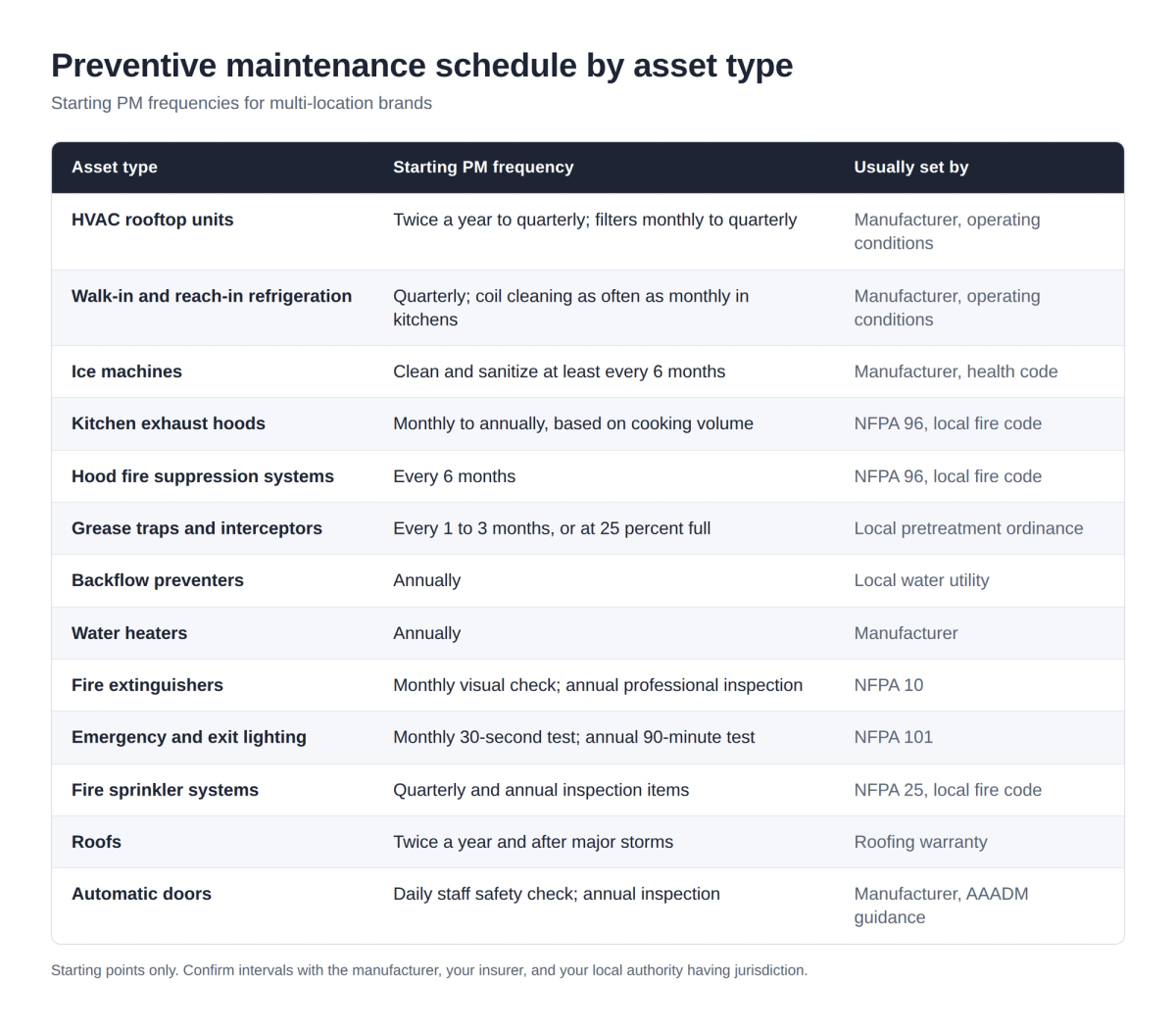
Preventive maintenance schedule by asset type
How often should commercial HVAC be serviced?
Rooftop HVAC units should be serviced professionally at least twice a year. Once before cooling season. Once before heating season.
Many restaurants and grocery stores move to quarterly visits. Kitchen grease and long run times lead to faster coil coating.
The exception to the twice a year frequency is filters. Plan for monthly to quarterly changes. Based on dust, grease, and foot traffic. A good HVAC checklist includes belts, coils, refrigerant pressures, electrical connections, and condensate drains. This ensures each provider checks the same things at each site.
How often should commercial refrigeration be serviced?
PM for walk-in coolers, freezers, and reach-in units is typically quarterly. Condenser coil cleaning as often as monthly in commercial kitchens.
Dirty condenser coils are one of the leading causes of refrigeration failures. Daily temperature logs and monthly door gasket checks are something store staff can do. This can catch minor issues between provider visits.
For ice machines, cleaning and sanitizing should occur at least every 6 months (according to most manufacturer guidelines). More frequently if you have hard water. Change water filters based on the manufacturer's schedule.
How often should kitchen exhaust hoods be cleaned?
Kitchen exhaust hood cleaning frequency is based on cooking volume. NFPA 96 defines it from monthly to annually.
According to NFPA 96, if you have systems that serve solid fuel cooking, they should be cleaned monthly. If you have high volume kitchens (24 hour operations, charbroiling, wok cooking) they should be cleaned quarterly. If you have moderate volume kitchens they should be cleaned twice a year. If you have low volume kitchens they should be cleaned annually. For hood fire suppression systems, they should be inspected by a licensed professional every 6 months.
Fire marshals and insurers ask for these records. Save the service report with each completed visit.
How often should grease traps be pumped?
For most restaurant grease traps/interceptors, they need to be pumped every 1-3 months. Or sooner if fats, oils, and grease reach 25% full in the trap.
Many cities define the frequency in a pretreatment ordinance. They also require pumping manifests. Since requirements vary by municipality, you may need a different frequency for each jurisdiction in a multi-site schedule.
How often should plumbing assets be serviced?
Typically backflow preventers need to be tested once a year. The local water utility usually requires a certified tester to file results. For commercial water heaters, it's beneficial to flush them annually to clear sediment. More frequently if you have hard water.
How often should fire and life safety equipment be inspected?
Fire extinguishers should have a visual monthly check. And an annual inspection by a certified provider (according to NFPA 10).
For emergency/exit lighting, they need a monthly 30 second function test. And an annual 90 minute test (according to NFPA 101). Staff can perform the monthly tests. As long as they are logged. Fire sprinkler systems are based on NFPA 25. This includes quarterly and annual inspection items. Your local fire authority may have more.
How often should roofs and doors be inspected?
Commercial roofs should be inspected twice a year. And after major storms. Many roofing warranties require documented inspections to remain valid.
Automatic doors need a daily safety check by store staff. And an annual inspection by an AAADM (American Association of Automatic Door Manufacturers) certified technician.
When to change PM frequency?
Change the PM frequency when the repair history indicates the current frequency isn't working.
If you are getting reactive calls between visits on a certain type of asset, then shorten the frequency. If you don't find anything during a year of visits at a location, you might be able to extend it. As long as it isn't a code required task. It's easy to make these decisions by reviewing spend and repair count by asset type each quarter.
How to implement a PM schedule across all locations
The most reliable way to implement a multi-location PM schedule is to define the frequency once by asset type. Then turn these into recurring work orders for each location.
1. Create asset list
Record the model, serial number, and warranty by location for each asset. Use QR code tags so technicians can confirm they serviced the right unit.
2. Define a default frequency per asset type
Start with the table above. Then override for specific sites based on climate, volume, or local code.
3. Create recurring work orders with checklists
Assign each work order to a service provider by trade and location. Attach the checklist so each visit includes the same items.
4. Track upcoming, completed, and overdue PM
If you have overdue visits at 1-2 locations, this is an early warning that a provider is falling behind.
Common PM scheduling mistakes
- Use one schedule for all climates. An HVAC unit in Phoenix is working much harder than the same unit in Seattle. Its PM frequency should reflect that.
- Schedule visits without checklists. If you don't have a checklist, then each provider determines what's included in a PM visit. This results in varying experiences by site.
- Spreadsheets for tracking code required tasks. Hood cleanings and backflow tests are missed if they are kept in one person's files vs. a shared system.
- Don't revisit frequencies. If you defined a frequency 5 years ago, it may not reflect the current operation of a location.
Frequently asked questions
What is the difference between preventive and predictive maintenance?
Preventive maintenance is based on a schedule. Predictive maintenance is based on sensor data or condition readings indicating an asset needs attention. Most multi-site brands use preventive maintenance as the baseline.
What should be included on a preventive maintenance checklist?
The PM checklist should include all the inspections and service tasks for the asset type. Fields for readings, photos, notes. It's beneficial to have one checklist per asset type. This way you can compare across locations.
Who determines PM frequency for an asset?
Start with the manufacturer's recommendation. But codes or insurers might require shorter frequencies. You make the final decision based on how hard the asset is working at each site.
Can we use our current service providers on a new PM schedule?
Yes. With OpenWrench, you can bring in your current service providers. They join WrenchHub for free. No per invoice fees. They get recurring PM work orders in the same app they use to submit invoices.