
The Complete Guide to Maintenance Scheduling for Facility ManagersMatt Velker
Matt Velker
Matt Velker
- What is maintenance scheduling
- Maintenance planning vs. maintenance scheduling
- Types of maintenance scheduling
- Why maintenance scheduling matters for facility managers
- Benefits of effective maintenance scheduling
- The maintenance scheduling process
- Best practices for maintenance scheduling
- Common maintenance scheduling challenges
- How to choose maintenance scheduling software
- KPIs to measure maintenance scheduling success
- Simplify maintenance scheduling across every location with OpenWrench
- Frequently asked questions about maintenance scheduling
In This Post
A broken freezer at 2 AM. An HVAC failure during a summer heat wave. A flooded restroom right before the lunch rush. These emergencies share something in common: most were preventable with proper maintenance scheduling.
Maintenance scheduling organizes when tasks happen and who performs them, turning reactive scrambling into proactive control. This guide covers the fundamentals of scheduling, best practices, common challenges, and the metrics that reveal whether your approach is actually working.
What is maintenance scheduling
Maintenance scheduling assigns tasks to a timeline so assets are serviced before breakdowns occur. It answers two questions: who does the work, and when does it happen? That shift moves operations from reactive repairs to proactive efficiency, where problems are addressed before they cause disruption.
It bridges knowing what work needs doing and actually getting it done. A maintenance plan specifies that your HVAC system requires filter changes and coil cleaning. The schedule determines that technician Maria performs this work Tuesday at 9 AM during low occupancy.
The goal is straightforward: minimize unexpected downtime and extend asset lifespans without disrupting operations. For multi-location businesses like retail chains, restaurants, or fitness centers, effective scheduling is what keeps every location in consistent condition.
Maintenance planning vs. maintenance scheduling
These terms often get used interchangeably, but they represent distinct steps in the maintenance workflow. Planning defines scope, identifies required parts, and establishes the procedures a technician will follow. Scheduling places that planned work on a calendar with assigned personnel.
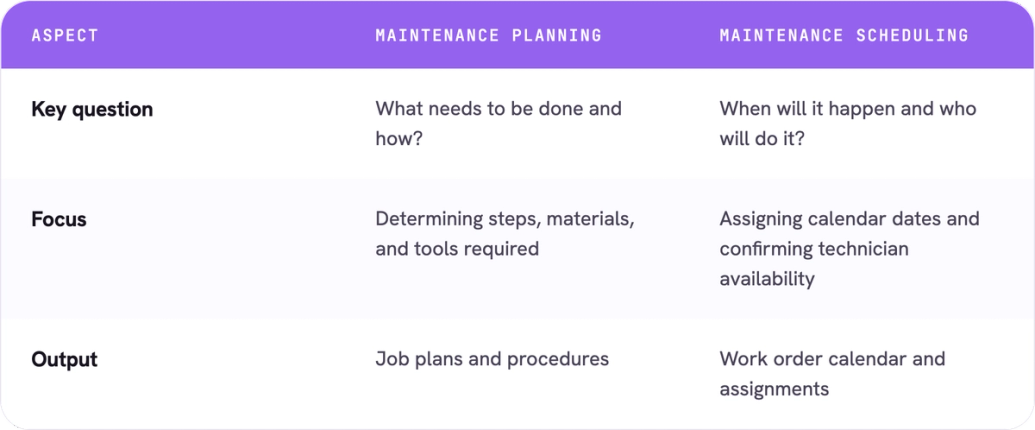
Well-planned jobs without proper scheduling sit in limbo. Scheduled work without adequate planning leads to unprepared technicians, missing parts, or the wrong skills on site.
Types of maintenance scheduling
Not all maintenance follows the same rhythm. Your approach depends on equipment, industry requirements, and operational priorities.
- Time-based scheduling: Tasks at regular intervals for routine inspections, filter changes, and general servicing.
- Usage-based scheduling: Maintenance triggered by operational metrics like runtime hours, production cycles, or miles traveled. A commercial kitchen might schedule hood cleaning after every 500 operating hours rather than every month.
- Condition-based scheduling: Service scheduled based on real-time equipment performance data from sensors or inspections.
For diverse equipment—gym machines, HVAC, pool filtration—most operators use a combination of all three approaches.
Why maintenance scheduling matters for facility managers
Unplanned equipment failures cost money in repairs. They also disrupt the customer experience, stress your team, and create safety hazards. Effective scheduling addresses these risks before they materialize.
- Reduces downtime: Servicing assets proactively means fewer surprise breakdowns during peak business hours. A restaurant doesn't want its walk-in cooler failing during the dinner rush.
- Optimizes resources: Align technician availability, parts inventory, and vendor schedules in advance.
- Improves efficiency: Proper scheduling sequences tasks logically, avoiding conflicts for technicians or equipment.
Benefits of effective maintenance scheduling
Reduced equipment downtime
Every hour of unexpected downtime costs lost revenue, frustrated customers, and stressed employees. Scheduling routine service catches small issues before they become major failures, keeping operations running smoothly.
Lower maintenance costs
Emergency repairs cost more than planned work and eat into margins—especially in restaurants, where a commercial kitchen maintenance plan can head off the most expensive failures. When you schedule maintenance in advance, you can source parts at better prices, avoid overtime labor charges, and coordinate with vendors during their regular availability windows.
Improved equipment performance and lifespan
Regular scheduled servicing makes equipment run more efficiently and last longer. An HVAC system with clean filters and maintained coils uses less energy and experiences fewer compressor failures than one that only gets attention when something breaks.
Stronger safety and compliance
Many industries require documented maintenance for compliance—restaurants, for instance, must stay inspection-ready at all times. Scheduled inspections meet those requirements consistently and catch hazards before they cause injuries, which makes preparing for a health inspection far less of a scramble.
Better resource utilization
With a clear schedule, technicians spend more time turning wrenches and less time waiting for parts or traveling between sites. Your maintenance budget goes further when resources are allocated intentionally rather than reactively.
The maintenance scheduling process
Step 1. Identify and prioritize work
Assess which tasks require scheduling based on asset criticality, safety risk, and operational impact. A failed freezer in a restaurant kitchen demands higher priority than a squeaky hinge.
Step 2. Allocate resources and labor
Match each task to available technicians with the right skills. Confirm parts are in stock or deliverable before the scheduled date, and reserve any specialized tools.
Step 3. Assign work orders and set timelines
Create work orders with clear instructions, realistic deadlines, and specific technician assignments. Include details like equipment location, access requirements, and any safety precautions.
Step 4. Communicate the schedule
Distribute the schedule to maintenance staff, vendors, site managers, and operations teams. When everyone knows what's coming, you avoid the conflicts that surprises create.
Step 5. Execute, track, and adjust
Monitor work completion, document results, and capture findings that affect future scheduling. A technician's discovery during an inspection—plumbing wear, say—feeds back into planning.
Best practices for maintenance scheduling
1. Centralize communication across teams and vendors
Different communication channels cause information to get lost among site managers, technicians, and vendors. A single platform eliminates the phone tag and email chains that delay repairs. Platforms like OpenWrench provide real-time messaging that keeps every stakeholder aligned.
2. Digitize your scheduling workflow
Spreadsheets can't send reminders, track status in real time, or surface maintenance analytics. Maintenance scheduling software closes these gaps—automating recurring work orders and giving you visibility across all locations from one dashboard.
3. Prioritize work by criticality and risk
Not all maintenance tasks carry equal weight. Focus effort on critical equipment where failures cause the highest safety or financial impact. A broken point-of-sale system affects revenue immediately; a flickering light can wait.
4. Build a skills matrix for your technicians
Track technician certifications, specialties, and experience levels. Assigning the right person improves first-time fix rates and prevents costly callbacks.
5. Schedule close to—but not at—full labor capacity
Booking technicians at 100% capacity leaves no room for emergencies. Many schedulers reserve 10–15% buffer time for urgent situations so a single emergency doesn't derail the preventive plan.
6. Create SOPs for recurring tasks
Standard operating procedures ensure any qualified technician completes routine work consistently. Documented procedures also speed up training for new team members.
7. Plan for emergency and reactive work
Even the best preventive program can't eliminate every emergency. Establish a structured process for urgent situations, with clear escalation paths and after-hours contacts.
8. Group tasks by location or asset
When a technician is on-site, layer additional maintenance tasks together. This reduces travel time and minimizes disruption to operations.
9. Use historical data to forecast needs
Past work orders and failure patterns reveal trends. If a piece of equipment consistently needs repairs every six months, adjust your preventive schedule to get ahead of it.
10. Track KPIs and continuously improve
Review scheduling performance on a regular cadence and refine the process based on what the data shows. The teams that improve are the ones that measure.
Common maintenance scheduling challenges
Conflicting priorities and resource constraints
When urgent requests compete for limited technicians and budget, something has to give. Clear prioritization criteria help you make those calls consistently rather than reactively.
Poor communication between teams and vendors
Information silos lead to missed appointments, duplicated work, and delayed repairs. A vendor might arrive when the site manager isn't available, wasting everyone's time.
Reactive work disrupting the plan
Emergency breakdowns can derail carefully planned schedules. Without buffer capacity, one urgent repair cascades into a backlog of postponed work.
Inaccurate or incomplete asset data
Missing equipment information leads to wrong parts, unprepared technicians, and failed calls. Accurate asset records—model numbers, service history, warranty details—prevent those problems.
Coordinating across multiple locations
Managing schedules across dispersed sites with different requirements, time zones, and vendors adds complexity. Centralized visibility becomes essential at scale.
How to choose maintenance scheduling software
Real-time communication and messaging
Look for instant messaging between site staff, technicians, and vendors inside the platform. This removes the delays and confusion of phone calls and email threads.
Planned maintenance and work order automation
The software should auto-generate recurring work orders based on calendar intervals or meter readings. Creating routine tasks by hand wastes administrative time.
Asset and vendor management
Confirm the platform can track equipment details, service history, warranties, and vendor contacts—and that the information is accessible to anyone who needs it.
Multi-location visibility and reporting
Prioritize dashboards that show maintenance status across all sites with trend analytics. You don't want to log into separate systems for each location.
Mobile access for field technicians
Mobile apps let technicians receive assignments, update status, and document work from anywhere. Desktop-only tools create delays and data gaps.
KPIs to measure maintenance scheduling success
Schedule compliance
The percentage of scheduled work orders completed on time. High compliance indicates your scheduling process is realistic and well-executed.
Planned maintenance percentage
The ratio of planned preventive work to reactive emergency repairs. Industry benchmarks suggest targeting 80% planned work or higher.
Mean time between failures (MTBF)
The average operating time between equipment breakdowns. A rising MTBF indicates your preventive maintenance is improving asset reliability.
Wrench time
The percentage of time spent on actual maintenance versus traveling, waiting, or administrative tasks. Higher wrench time means better productivity.
Work order backlog
The total number of open work orders awaiting completion. A growing backlog signals your scheduling capacity isn't keeping pace with demand.
Simplify maintenance scheduling across every location with OpenWrench
Managing maintenance across multiple locations doesn't require juggling spreadsheets and chasing vendors. OpenWrench centralizes communication, automates recurring maintenance, and provides multi-location visibility—coordinating vendors, tracking assets, and making sure every maintenance request gets handled. For industry-specific breakdowns, see the guides to the best CMMS for restaurants, gyms, and retail stores.
Schedule a demo to explore how OpenWrench can simplify your maintenance management.
Frequently asked questions about maintenance scheduling
What is the 30-60-90 maintenance schedule?
The 30-60-90 schedule is a tiered approach used in vehicle and equipment maintenance. Different service tasks are performed at 30-day, 60-day, and 90-day intervals based on wear patterns and manufacturer recommendations. Lighter tasks happen more frequently; intensive services occur at longer intervals.
How often should a facility maintenance schedule be reviewed and updated?
Most facility managers review and adjust their maintenance schedules monthly or quarterly. This accounts for seasonal changes, new equipment, shifting priorities, and lessons learned from completed work. Major operational changes like new locations or equipment warrant an immediate update.
Who is typically responsible for creating a facility maintenance schedule?
Facility managers or maintenance supervisors typically own the scheduling process. They collaborate with technicians, vendors, and operations managers to keep the schedule aligned with business requirements and resource availability.
How does maintenance scheduling software differ from a basic spreadsheet?
Maintenance scheduling software automates recurring work orders, sends real-time notifications, tracks completion status, stores asset history, and provides analytics. Spreadsheets require manual updates and lack the communication features that keep teams aligned. According to IBM's overview of preventive maintenance, structured maintenance programs help reduce unplanned downtime and extend asset lifespans.