
Meet Oscar! What an AI Work Order Management Agent Does for Multi-Location Teams

Katie Towler
- How Oscar helps multi-location teams scale
- What an AI agent is, and what it is not
- What AI work order management looks like in practice
- From answer to next step
- Working with your service providers
- Finding problems that repeat
- Questions to ask any AI vendor
- What to check before you try Oscar
- FAQs
In This Post
Meet Oscar! What an AI Work Order Management Agent Does for Multi-Location Teams
Thanks to our new AI agent, Oscar, AI in work order management is changing from just a buzzword to the reality for multi-location facilities teams. When you manage maintenance across dozens or hundreds of sites, a lot of the work is knowing what needs to be done, and by who. An AI agent can take on the first pass of sorting and drafting notes, and leave the decisions to your team.
How Oscar helps multi-location teams scale
Across dozens of locations, a work order that quietly sits un-done at one site rarely looks urgent from the outside. Deadlines get missed, follow-ups don’t happen, and it’s easy to miss the patterns that emerge with this data. That is where our AI agent, Oscar, earns his place: he reads every open work order at once and points to the ones that need a person, as well as identifying repetitive issues to watch out for.
The benefit builds with each location you add. A backlog that one coordinator could track across five sites becomes hard to follow across fifty, and the cost shows up as longer repair times, repeat visits, and equipment that stays down.
What an AI agent is, and what it is not
An analytics dashboard shows you data and leaves it up to you what you should do with it. A chatbot answers general questions but knows nothing in depth about your facilities. An AI agent like Oscar sits in between and goes further: he works from your own work orders, answers questions about them, and prepares the next step. The difference matters for facilities teams, because most of the delay in maintenance isn’t from missing data; it comes from the time between identifying a problem and doing something about it.
It also helps to be clear about what Oscar does not do. He does not replace your facilities managers, your regional managers, or your service providers. He handles the first pass of reading, sorting, and drafting so the people who know your locations can spend their time on judgment calls.
What AI work order management looks like in practice
Instead of building yet another report, you ask Oscar a question in plain language: “how many work orders are past due right now?”, or “how much have we spent on HVAC in the past three months compared with the same period last year?”. Oscar answers from your work orders, invoices, and other relevant data.
Here are some more examples for how to use Oscar in OpenWrench. A facilities leader asks how much the team spent on a specific location or region so far this year, and how that compares with the same period last year. Oscar returns both totals and the categories behind the change. The next question, how many work orders are past due, gets a count and then the full list, sorted by priority and due date. Without an agent, the same answers might mean exporting a list, filtering it, and cross-checking service provider notes. With Oscar, they show up next to the work orders themselves. Each answer builds on the last, so the conversation ends with a clear picture instead of a spreadsheet to maintain.
This is an illustration of the kind of questions teams ask, not a promise of any specific result. Your answers depend on the data in your own work orders and invoices, which is why the checklist later in this post matters.
From answer to next step
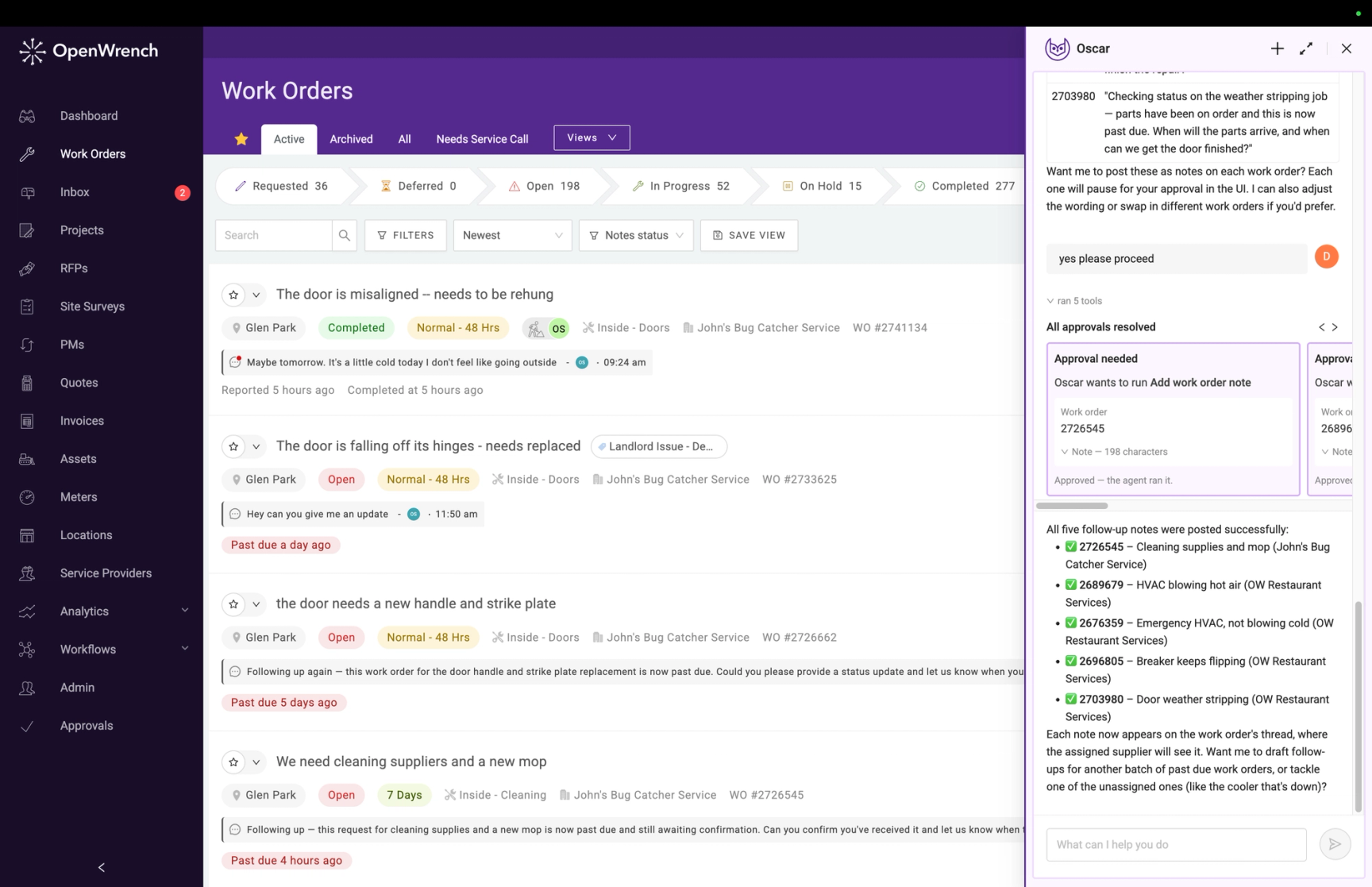
Answers help, but what you really care about is action. Typically, once a team spots a backlog, someone has to write follow-up notes and reassign work. Not with Oscar. With Oscar, once you identify a list of past-due open work orders, Oscar can draft a note on each asking for an estimated time of arrival (ETA) or a status update. He shows you every note and gets your approval before anything posts, leaving the judgement calls up to your team. He can also assign work orders to the next service provider. Oscar always asks for your approval before he updates anything, so people stay in control.
Working with your service providers
Most of the wait time in maintenance happens between your team and the service provider doing the work. A work order doesn’t get done on time, someone has to ask for an update, and the answer often comes back by phone or email, where the rest of the team can't see it.
Oscar puts that follow-up on the work order itself. Ask him to request an ETA on every past-due work order with a provider assigned, and he drafts a note on each one. Once you approve, the notes post to the work order threads, so each provider's reply lands in the same place and your team can see where every repair stands.
This works because your providers are already in OpenWrench. They join WrenchHub free, with no per-invoice fees, and they reply and send invoices in the app.
Finding problems that repeat
Patterns hide in work order history: some locations cost more to maintain than others, certain assets break down more often, or an individual asset may score below standard across several inspections. An agent can surface those patterns and point your team toward the root cause, so you have the data you need to make better decisions moving forward.
Questions to ask any AI vendor
Whether you are looking at Oscar or any other AI agent for facilities maintenance, a few questions separate a useful tool from a flashy demo:
- Does the agent work from your own work orders and invoices, or from general information?
- Does it ask for approval before it changes anything, and can you see exactly what it plans to change?
- Does it fit the way your admins already work, or does it add another system to learn?
- Can you try it on real questions from your own team instead of a scripted example?
We built Oscar to answer yes to each of those. Ask the same questions of everyone you evaluate, including us.
What to check before you try Oscar
Any AI agent works with what it finds, so a few basics matter:
- Make sure your work order notes are specific enough to read months later.
- Keep service provider assignments current.
- Attach invoices to the correct work orders.
- Make sure someone on your team owns the approval step.
FAQs
Will an AI agent replace my team?
No. Oscar prepares follow-ups and finds stale work orders. Your team reviews and approves them, and still talks to service providers. Oscar will never replace human judgement.
Can an AI agent change work orders without my approval?
Oscar asks for your approval before he updates anything, so nothing changes until a person says yes.
Who can use Oscar?
Oscar is for OpenWrench admins. He works inside the workflow your team already uses, so technicians have nothing new to learn.
What should my data look like before I start?
Specific work order notes, current service provider assignments, and invoices attached to the right work orders. The checklist above covers each one.
What can I ask Oscar?
Get creative! Questions about your work orders and spend, such as how many work orders are past due or how your HVAC spend over the past three months compares with last year. But it’s really up to you how you use Oscar, and we’re consistently building out additional functionalities.
What does approval look like?
When Oscar has an update to make, he shows it to you first, such as the note he plans to add to a work order. Someone on your team approves or rejects each one, or approves a batch at once. If the answer is no, nothing changes.
Do I need to clean up my data first?
You do not need perfect data, but clearer notes, current provider assignments, and correctly attached invoices give Oscar more to work with, and you will see better answers because of it.
Is this only for large teams?
Oscar is built for multi-location brands, and the value grows with the number of sites you manage. If your team spends hours each week asking where work orders stand, an AI agent is worth a look.
Learn more about how Oscar works on the AI Agents page, or book a demo to see him with your own locations.