Meet Oscar, the AI agent who handles all your busy work! Learn more

Preventive vs. Reactive Maintenance Costs for Multi-Location Facilities

Katie Towler
- What is the difference between preventive and reactive maintenance?
- How much more does reactive maintenance cost?
- When does reactive maintenance make sense?
- How do multi-location teams shift spend from reactive to preventive?
- Common mistakes that keep maintenance reactive
- Frequently asked questions
In This Post
In the preventive vs reactive maintenance debate, preventive maintenance wins on long term costs, and the gap grows with every location in your portfolio. Reactive repairs come with emergency rates and lost sales that a scheduled visit often avoids.
For brands running dozens or hundreds of commercial locations, the choice is rarely all one or the other. Most facilities teams run a mix. The real question is how much of your maintenance spend is planned, and how much arrives as a surprise invoice on a Saturday night.
This guide breaks down where reactive maintenance costs actually come from, when running equipment to failure is a reasonable call, and how multi-location teams shift spend toward planned work without adding headcount.
What is the difference between preventive and reactive maintenance?
Preventive maintenance is scheduled service done on a regular basis to help prevent equipment failures, while reactive maintenance is repair work done after something breaks.
What is preventive (or planned) maintenance?
Preventive maintenance (PM) is recurring service performed on a set interval, such as quarterly coil cleanings on walk-in coolers or monthly filter changes on rooftop HVAC units. Many teams call it planned maintenance. The goal is to catch wear early, while the fix is still small and cheap.
What is reactive maintenance?
Reactive maintenance, sometimes called run-to-failure or breakdown maintenance, means waiting for a problem and then fixing it. In commercial facilities, it usually starts with a store manager reporting a warm cooler or a dead rooftop unit, followed by an urgent call to a service provider.
Here's how the two compare in a multi-location operation:
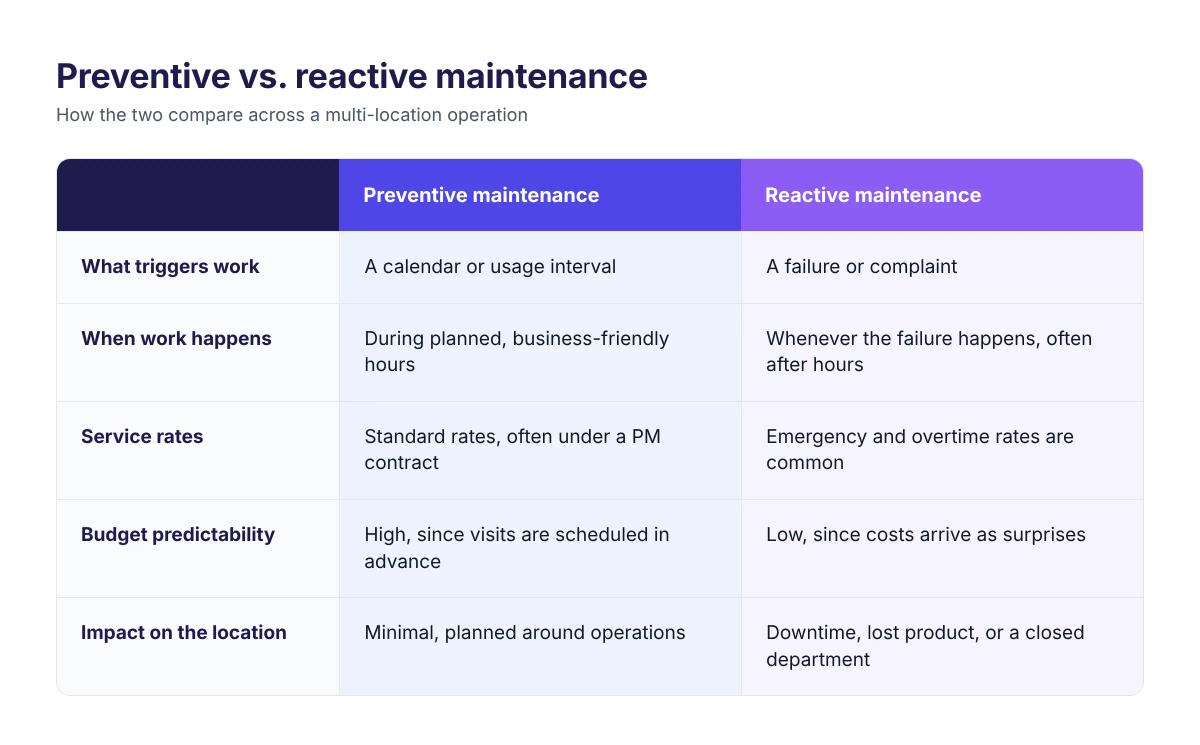
How much more does reactive maintenance cost?
Reactive maintenance usually costs more per asset each year than preventive maintenance, though the exact gap depends on your equipment mix and service provider rates.
Be careful with industry multipliers. Claims that reactive work costs "3 to 5 times more" are widely repeated, but they don't trace back to a documented study, and most older benchmarks were measured in industrial plants. Your own repair history is the most reliable benchmark for your locations.
The invoice total only captures part of the picture. For commercial facilities, the larger costs sit outside the repair invoice.
The direct costs of a reactive repair
Emergency calls rarely happen at a convenient time. A refrigeration failure on a Friday night means after-hours rates and, often, expedited shipping on parts.
Small problems also grow when nobody's looking. A dirty condenser coil makes a compressor work harder for months. By the time the cooler stops holding temperature, a cleaning visit has turned into a compressor replacement.
The hidden costs multi-location brands feel
The costs that hurt most never show up on the service provider's invoice:
- Lost product and sales. A failed walk-in at a restaurant or grocery store can mean discarded inventory and a menu or department that's unavailable until the repair is done.
- Shorter equipment life. Equipment that runs without regular service tends to wear out sooner, which pulls capital spending forward.
- Time spent chasing. Every emergency means calls, approvals, follow-ups, and an invoice to reconcile. Across 100 locations, that admin work becomes a full-time job.
- Unpredictable budgets. Reactive spend is hard to forecast, which makes conversations with finance harder every quarter.
Scale is what makes this expensive. One avoidable emergency call is an annoyance. The same avoidable call repeated at every location, every quarter, is a budget line.
When does reactive maintenance make sense?
Reactive maintenance makes sense for low-cost assets that don't affect sales or safety when they fail.
A burned-out light in a back hallway or a broken office chair doesn't need a PM schedule. Fixing those items when they break costs less than inspecting them on a calendar.
To sort your assets, ask two questions about each type. What happens to the location if it fails? And how long does it take to get it working again? Equipment that stops revenue or creates a safety issue belongs on a preventive schedule. Everything else can reasonably run to failure.
How do multi-location teams shift spend from reactive to preventive?
Multi-location teams shift spend by finding where reactive costs concentrate, putting their most critical assets on recurring schedules, and measuring the results across every site.
Step 1: Find where reactive spend is concentrated
Start with your repair history. Break reactive spend down by location, asset type, and service provider. Most brands find that a few asset types, usually HVAC and refrigeration, drive most of the emergency calls.
Step 2: Put critical assets on a preventive schedule first
Cover the equipment that costs the most when it fails before anything else. For most commercial facilities that means HVAC, refrigeration, grease traps, and fire and life safety systems. Our guide to preventive maintenance schedules by asset type lists typical service intervals for each.
Step 3: Automate the schedule with recurring work orders
Schedules kept in spreadsheets slip. Recurring work orders set by location, asset type, or specific asset keep visits on the calendar without anyone rebuilding them each quarter. Attach the same checklist to every visit so a PM at one location means the same thing as a PM at another. Our post on standardizing PM across 100+ locations covers this in detail.
Step 4: Keep your service providers and get them in one system
Planned maintenance works best with the service providers you already trust. Get them working from the same schedule and checklists, with updates and invoices in one place. In OpenWrench, service providers join WrenchHub free, so they actually use it.
Step 5: Track the ratio and adjust quarterly
Watch two numbers side by side: planned maintenance completion and reactive work order volume. If reactive calls on an asset type keep rising between PM visits, shorten the interval. If an aging unit keeps needing repairs despite regular service, repair history will tell you when it's time to replace it instead.
Common mistakes that keep maintenance reactive
- Cutting PM contracts to hit a quarterly budget. Skipped filter changes and coil cleanings save money for a few months, then come back as emergency calls at premium rates.
- Running PM without a checklist. Without a standard checklist and required photos, it's hard to know what a technician actually did on site.
- Measuring completion without measuring results. A 100% PM completion rate means little if reactive calls on the same assets aren't going down.
- Using one schedule for every climate. A rooftop unit in Phoenix needs more attention in summer than the same unit in Minneapolis. Set a default by asset type and adjust by region.
Frequently asked questions
Is preventive maintenance always cheaper than reactive maintenance?
Preventive maintenance is cheaper for critical, high-cost equipment, but not for every asset. Low-cost items that don't affect sales or safety are often cheaper to fix when they break.
What is a good ratio of preventive to reactive maintenance?
Many maintenance teams aim for roughly 80% planned work and 20% reactive work as a long-term target. Treat it as a starting benchmark, then track your own ratio by asset type and region.
Is planned maintenance the same as preventive maintenance?
Yes, most facilities teams use planned maintenance and preventive maintenance interchangeably. Both describe scheduled service performed before equipment fails.
How do you calculate the cost of reactive maintenance?
Add up emergency repair invoices, after-hours premiums, and expedited parts for a period, then add the cost of lost product and downtime at affected locations. Comparing that total to your PM spend on the same asset types shows where planned maintenance will pay back fastest.
Can we keep our current service providers when moving to preventive maintenance?
Yes. With OpenWrench, your existing service providers join WrenchHub free, with no per-invoice fees, and they work from the same recurring work orders and checklists as the rest of your network.